Rush Builders
RUSH BUILDERS ROOFING AND SOLAR · 5.0 ★ ON GOOGLE
Hail damage hides — until it leaks. Get a free inspection before your claim window closes.
Free inspection · No obligation · Local & owner-operated
We call back within one business day.
“I used Robinson Chen for my new roof. He and his assistant, Paula, worked with me and my insurance company from start to finish. They answered all questions I had and was a great go between for me and the insurance company and adjuster. I highly recommend Rush Builders. You will not be disappointed.”
— Alexis Montgomery, Google review
“Rush Builders were amazing to work with on our roof replacement. They were honest, patient, responsive, and transparent, ensuring we were comfortable throughout the entire process and taking care of all inquiries from the insurance company. The roof turned out great and I highly recommend Rush Builders!”
— Tanya Lopez, Google review
“Rush Builders did an outstanding job on our roof replacement and inspection process. The team was professional, responsive, and extremely knowledgeable about hail damage and insurance claims. They showed up on time and communicated clearly.”
— Lucas Stanley, Google review
“I used Robinson Chen for my new roof. He and his assistant, Paula, worked with me and my insurance company from start to finish. They answered all questions I had and was a great go between for me and the insurance company and adjuster…”
— Alexis Montgomery, Google review
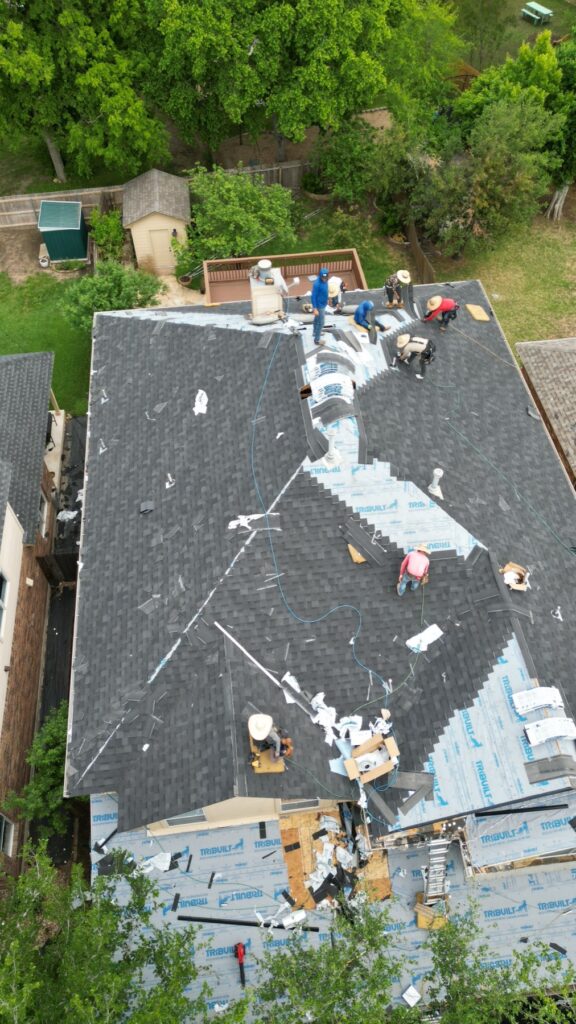
Check the ground, not the roof: granules piling in gutters, dents on your AC unit or window screens, shingles in the yard — or roofing crews all over your street. South Austin neighborhoods like Circle C, Shady Hollow, and Onion Creek sit right in Central Texas hail alley and take hits season after season.
Don’t climb up there, and don’t call your insurance company blind. Know what you have first.
Photograph what you see
Dents, granules, fallen shingles — from the ground, with the storm date.
Get our free inspection
We document every slope properly — the difference between an approved claim and a denied one.
We support your claim
Documentation for your filing, on-site adjuster meeting, and if they say no — a deeper re-inspection to back your appeal.
A hailstone the size of a quarter falls at around 25 miles per hour. One inch of ice hitting your shingles at that speed doesn’t usually punch a hole — it does something sneakier. It crushes the granule layer into the asphalt mat underneath, knocking granules loose and bruising the mat the way a fist bruises an apple: intact on the surface, broken underneath.
Those granules are the shingle’s sunscreen. Once they’re gone, Texas UV goes to work on the exposed asphalt — drying it, cracking it, aging that spot years in a single summer. This is why hail-hit roofs often don’t leak until 6 to 18 months after the storm, long after the homeowner decided everything was fine. By then, connecting the leak to the storm — and getting insurance to pay for it — is much harder than it would have been the week after.
Bruises. A fresh hail hit is a dark, roughly circular mark where the granules were blasted away — shiny black asphalt at first, weathering to dull gray. Press on it and it gives slightly, like a soft spot on fruit: that softness is the fractured fiberglass mat under the surface, and it’s why a shingle that “looks okay” from the driveway can be structurally finished.
Granules. Check where your downspouts drain after a storm. Piles of grit that look like coarse coffee grounds are your roof’s protective armor washing away. On the roof itself, granule loss concentrates on the slopes that faced the storm — hail is directional, and that lopsided pattern is one of the ways professionals separate hail from ordinary aging.
Soft metals. Aluminum vents, valley flashing, gutters, and AC fins dent at hail sizes that don’t yet total a shingle — adjusters read them like a rain gauge. If your roof vents are peppered with dings, the shingles around them took the same hits.
Wind’s signature. The same storms bring 60+ mph gusts that crease shingle tabs and break the adhesive seal. A creased shingle flips up by hand and never reseals properly — it’s a shingle-by-shingle failure you almost can’t see from the ground.

Adjusters chalk a 10-by-10-foot “test square” on each slope and count distinct hail impacts inside it — commonly, around eight qualifying hits means the slope qualifies for replacement. The entire claim can turn on what gets found inside those hundred square feet. Our job at the inspection is making sure every legitimate impact is found, circled, and photographed before the square is drawn — not discovered after the denial letter.
Research and insurance-industry experience put the threshold around 1 inch (quarter-sized) for most asphalt shingles — smaller with wind behind it, or on older roofs. The I-35 corridor through Austin, Round Rock, and Georgetown sees storms that size regularly, which is why so many local roofs carry damage their owners don’t know about.
You don’t have to guess and you don’t have to climb. After any storm with reported hail near your address, a professional inspection — every slope, all the soft metals, documented with photos — tells you exactly where you stand. If there’s a claim, you’ll have the evidence ready. If there isn’t, you’ll sleep better. Either answer is free.
Free inspection, honest answer, zero pressure — and if your roof is fine, we’ll tell you.