Rush Builders
RUSH BUILDERS ROOFING AND SOLAR · 5.0 ★ ON GOOGLE
Adjusters miss damage all the time. A proper re-inspection and real documentation change the answer more often than you’d think.
Free inspection · No obligation · Local & owner-operated
“I used Robinson Chen for my new roof. He and his assistant, Paula, worked with me and my insurance company from start to finish. They answered all questions I had and was a great go between for me and the insurance company and adjuster…”
— Alexis Montgomery, Google review
Free re-inspection
We walk every slope and document each hail hit and wind-lifted shingle — photos, measurements, storm dates.
We meet the adjuster
We request a re-inspection and stand on your roof with the insurance adjuster, pointing out exactly what was missed.
You get a fair outcome
Denials reversed, underpaid claims supplemented. If there’s no real claim, we tell you honestly — for free.
Quick walk-arounds miss hail bruising. Blurry photos don’t convince anyone. Real storm damage gets labeled “wear and tear.” And when the only professional at the inspection works for the insurance company — guess whose story gets told.
Turning that around is what Rush Builders Roofing and Solar is known for across South Austin, Round Rock, and all of Central Texas.
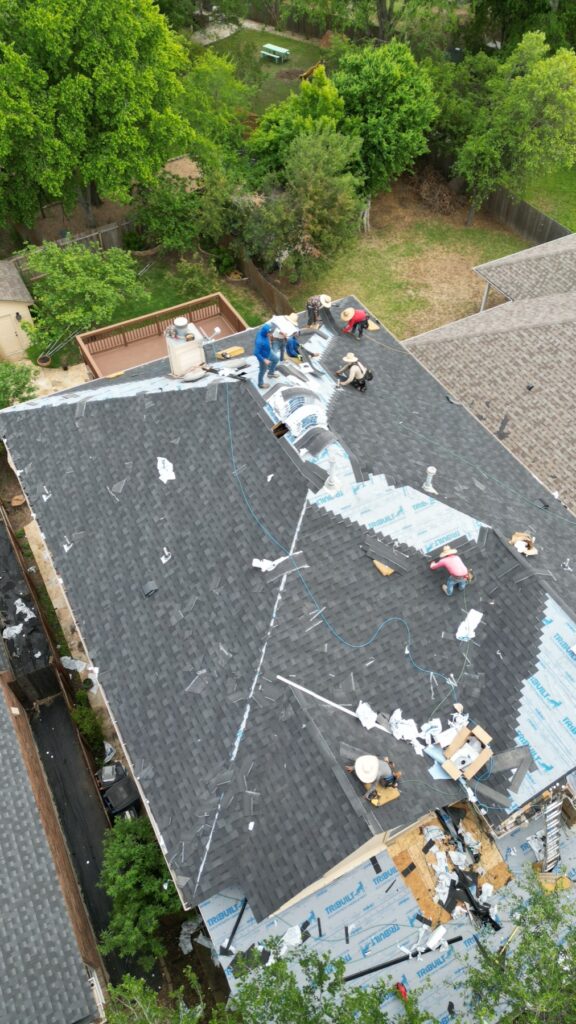
Roughly speaking, a roof claim gets decided in the twenty minutes an adjuster spends walking your roof. Adjusters are often handling dozens of inspections a week after a major storm, and hail damage — especially early-stage bruising — is genuinely easy to miss if nobody is up there pointing it out. A denial usually doesn’t mean your roof is fine. It means the damage wasn’t found, wasn’t documented, or was attributed to the wrong cause.
Most denial letters we see in the Austin area blame “wear and tear,” “manufacturing defects,” or “mechanical damage” — none of which are covered by insurance. But real hail damage has fingerprints: random impact patterns (weather doesn’t hit in straight lines), granule loss with exposed black mat, bruises that feel soft like an apple, and matching dents on soft metals — vents, flashing, gutters — that only hail can leave. A trained eye can tell the difference. That’s exactly what a re-inspection is for.
A denial is not final. In Texas you can request a re-inspection, and you’re allowed to have your own contractor present when the adjuster returns. That second visit is a different conversation entirely: instead of a quick solo walk-around, there’s a professional on your side of the roof showing the adjuster each impact point, with photos, chalk marks, and dates matched to documented storm events for your address.
Most policies expect storm claims to be filed promptly, and waiting many months after a hailstorm makes every part of the process harder — damage weathers, evidence blurs, and insurers get more skeptical. If your claim was denied or you suspect your last storm was never inspected properly, the free re-inspection costs you nothing and settles the question either way.
Texas law (House Bill 2102) makes it illegal for a contractor to pay, waive, or absorb your insurance deductible. Anyone offering to “eat your deductible” is breaking the law and telling you exactly how they run their business. We don’t — and the homeowners who work with us keep their claims clean and their coverage intact.

When we walk a roof after a denial, we build the file the insurance company can’t argue with: dated overview photos of every slope and elevation, close-ups of each impact with chalk marks for scale, a full inventory of dented soft metals (vents, flashing, gutters, the AC condenser fins), certified weather data confirming hail at your specific address on a specific date, and an itemized repair scope written in the same estimating software the insurers themselves use. Denials survive vague complaints. They rarely survive that file.
First: many Texas policies pay replacement cost in two steps — a depreciated amount up front, with the rest (“recoverable depreciation”) released only after the work is completed. That’s normal; don’t let a low first check convince you the claim failed. Second: many newer policies carry percentage deductibles — 1% or 2% of your home’s insured value, not a flat $1,000 — so knowing your real number before you file matters. We walk through both with you before anything is signed.
Free inspection, honest answer, zero pressure — and if your roof is fine, we’ll tell you.