
What Does a Roof Replacement Cost in Austin?
“How much is this going to cost me?” is the first question every homeowner asks, and it’s a fair one. A roof is one of the biggest checks you’ll ever write on your house. The honest answer is: it depends, but not in a vague, dodge-the-question way. A handful of specific things move the number up or down, and once you know what they are, a quote stops feeling like a mystery. Here’s a straight-talk breakdown, in plain English.
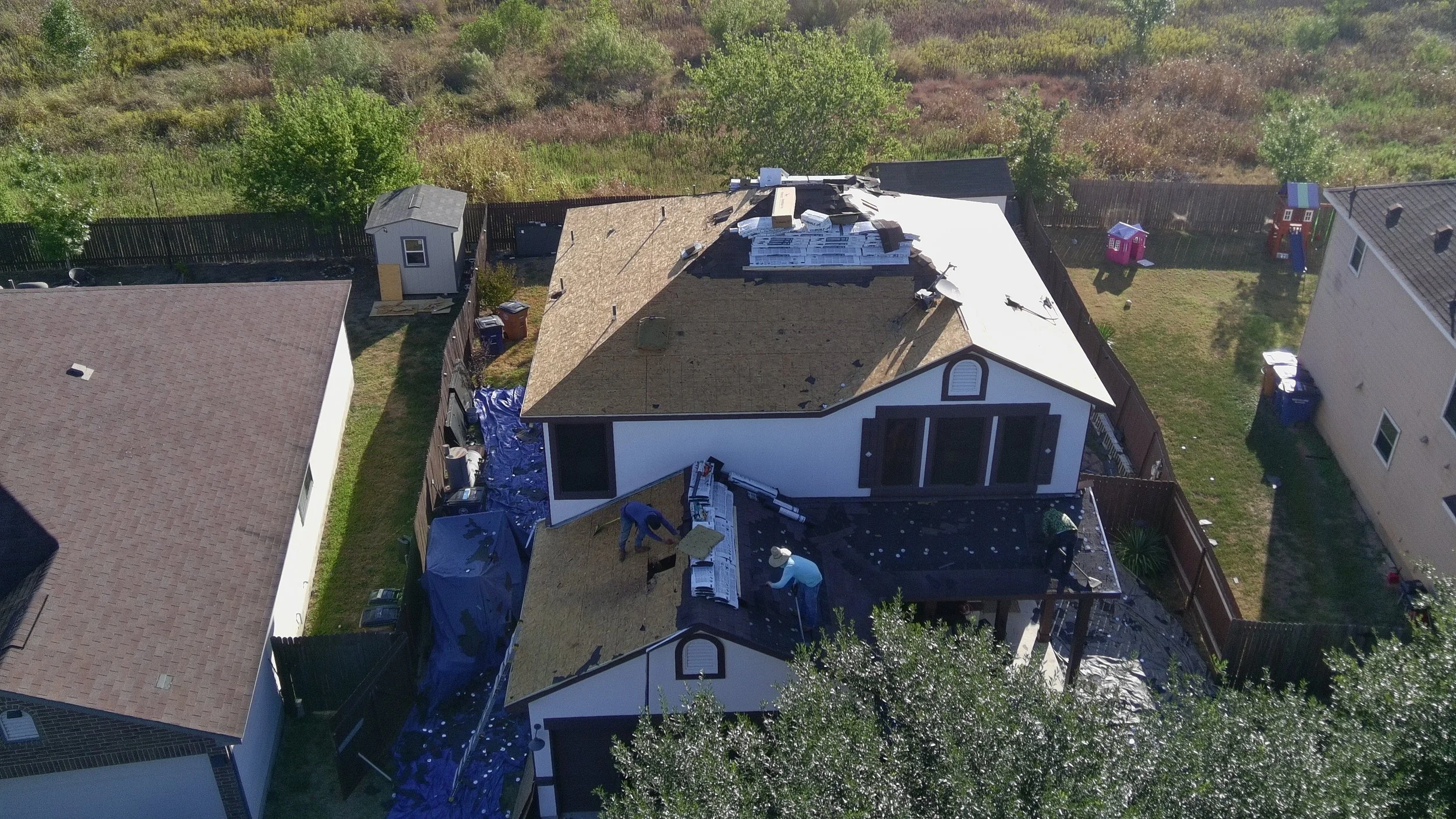
The realistic 2026 price range for Austin
For a typical single-family home in the Austin metro getting a full asphalt shingle roof replacement, we’re seeing jobs land somewhere between $12,000 and $25,000+ in our experience. That’s a wide range on purpose. It’s a wide range in real life. A small, simple ranch-style roof can come in near the bottom. A large, steep, multi-gabled roof with a lot of valleys and a premium shingle can push well past the top. If someone quotes you $6,000 for a full tear-off or $45,000 for a standard asphalt roof without a very specific reason, that’s a signal to ask more questions, not just take the number at face value.
Think of that range as a starting point for a conversation, not a promise about your house specifically. The only way to get a real number is to have someone measure your actual roof and look at what’s underneath it. That’s exactly what the factors below cover.
The 6 factors that actually move your price
1. Size (squares)
Roofers measure in “squares.” One square equals 100 square feet. More squares means more material and more labor, plain and simple. This is usually the single biggest driver of total cost, which is why two neighbors with similar-looking houses can get very different quotes if one roof is simply bigger.

2. Pitch and complexity
A steep roof is slower and more dangerous to work on than a flat, walkable one, which raises labor cost. Complexity matters too, every valley, dormer, chimney, and roofline change adds cutting, flashing, and time. A simple rectangle roof and a roof with six different angles can be the same square footage and cost noticeably different amounts.
3. Shingle tier, including Class 4 impact-resistant
3-tab shingles are the most economical option. Architectural (dimensional) shingles cost more but last longer and look better. Class 4 impact-resistant shingles cost more up front than standard architectural shingles, but in Texas they can qualify homeowners for an insurance premium discount. Worth asking your insurance agent about directly, since the discount varies by carrier.
4. Decking condition discovered at tear-off
You can’t always see what’s under the old shingles until they come off. If the plywood decking underneath is rotted, water-damaged, or soft, it has to be replaced before new shingles go on. That’s a code and safety issue, not optional. This is the most common reason a final invoice comes in higher than the original estimate, and it’s why a trustworthy roofer explains decking replacement as a possibility up front rather than as a surprise add-on later.
5. Layers to remove
If your roof already has one or two layers of old shingles on it, tearing all of that off costs more in labor and disposal than a single-layer tear-off. Some older Austin homes have two layers stacked from past re-roofs. That’s extra dump-run weight and extra hours.
6. Code-required items
Modern roofing code calls for things like proper drip edge, synthetic or felt underlayment, and adequate ventilation. These aren’t upsells. They’re what keeps a roof performing and keeps you covered if something goes wrong later. A quote that skips these to look cheaper on paper is quietly cutting corners that matter.
Architectural vs. 3-tab vs. Class 4: which one is right?
3-tab shingles are the budget option: flat-looking, shorter lifespan, lowest material cost. They’re a reasonable choice on a tight budget but generally the first to show wear.
Architectural shingles (also called dimensional shingles) are the most common choice for Austin homes today: thicker, more wind-resistant, better-looking, and a solid middle ground on cost versus lifespan.
Class 4 impact-resistant shingles are built to hold up better against hail, which matters a lot in Central Texas. They cost more than standard architectural shingles, but the potential insurance premium discount can offset some of that difference over time. Ask your carrier for the exact percentage before you decide, since it’s not the same everywhere.
Why quotes differ between contractors
It’s normal to get three quotes on the same roof and see three different numbers. The differences usually come down to a few real things, not just someone being “cheaper”:
- Scope. Does the quote include new underlayment, drip edge, and flashing, or just shingles slapped over what’s there?
- Warranty. A manufacturer warranty plus a workmanship warranty from the contractor is worth something. A bare-minimum warranty (or none) usually means a lower price tag for a reason.
- Insurance and licensing overhead. A legitimately licensed, insured contractor carries costs that a fly-by-night crew doesn’t, and that difference shows up in the price.
- Storm-chaser lowballs. After a hail event, out-of-town crews sometimes show up with rock-bottom bids to win the job fast. Those numbers can be tempting, but ask where that company will be in two years if a shingle fails.
When insurance pays instead
If your roof damage is from a covered event, hail or wind most commonly here in Central Texas, your homeowners insurance may pay for some or all of the replacement, often covered depending on your policy and the extent of damage. We’re not able to guarantee coverage, since that decision belongs to your insurance company, but we do inspect for free, document the damage thoroughly with photos, meet your adjuster on-site to walk the roof together, and guide you through the process from there.
Red flag: If any contractor offers to “waive” or “cover” your insurance deductible, that’s illegal in Texas under Insurance Code chapter 707, for them and risky for you. It’s usually a sign the rest of the deal isn’t straightforward either. A legitimate roofer will never make that offer.
Red flags in cheap quotes
- No mention of decking. If a quote assumes zero decking replacement before ever opening up your roof, that’s a guess, not an inspection.
- Big upfront deposit, vague timeline. Legitimate local roofers don’t need most of the money before work starts.
- No proof of license or insurance. Ask for it in writing, if a company hesitates, that’s your answer.
- “Today only” pricing pressure. A real quote doesn’t expire in an hour. Pressure tactics are a sign of sales, not roofing.
- Missing code items. No underlayment or drip edge line item usually means it’s not in the price, and it’ll cost more to add later.
Questions to ask any roofer
- Are you licensed and insured, and can I see proof?
- What’s included, like underlayment, drip edge, flashing, and ventilation, versus what’s an add-on?
- What happens to the price if you find rotted decking once the old roof comes off?
- What warranty comes with the material, and what warranty comes with your labor?
- Can I see photos or talk to references from recent jobs in my area?
- How do you document damage for an insurance claim, and will you meet my adjuster on-site?
Where we fit in
We’d rather give you a real number after actually looking at your roof than a guess over the phone. Every estimate we give breaks down the squares, the pitch, the shingle option, and what we’re watching for at tear-off, so if something changes once we’re up there, it’s not a surprise, it’s a conversation. You can see examples of completed jobs around Austin on our project portfolio.
Want a real number for your roof, not a guess?
Get a free, no-pressure inspection. Call or text (857) 237-1884, Rush Builders Roofing and Solar, Pflugerville, TX. Se Habla Español.
